Emergent vs. Ontologically Impossible

Abstract
Most contemporary digital systems manage risk at runtime, allowing hazardous states to emerge and addressing them through mitigation, correction, or recovery mechanisms. This approach assumes that all states are, in principle, reachable, and that safety is enforced after execution paths already exist.
The ΣE approach introduces a different architectural paradigm. Instead of governing behavior after the fact, it constrains the system’s state space a priori by defining admissibility at the level of existence itself. Non-admissible state classes are excluded by design and cannot be represented, reached, or instantiated under any operational or fault condition.
This shifts safety and governance from runtime control to architectural invariants, reframing risk management as a problem of ontological design rather than reactive mitigation. The result is not a restriction of functionality or innovation, but a change in the level at which architectural decisions are made — from managing outcomes to defining what is possible in the first place.
Most digital systems (such as Android) are designed so that anything can emerge, and problems are handled after the fact: via resource limits, process termination, correction, or restart.
Risk appears first — then it is mitigated.
The ΣE approach works in the opposite direction.
This is not about banning applications, ideas, or functions.
Instead, it defines in advance which forms of system existence are not admissible at all.
If a system regime is ontologically non-admissible:
• it is not evaluated,
• not stabilized,
• not executed,
• and cannot “accidentally” emerge from signal or state combinations.
The difference is not behavioral control, but control of the space of possibility.
One approach mitigates risk after it appears.
The other removes the possibility for such risk to exist in the first place.
This is not a restriction of innovation —
it is a shift in the architectural level at which decisions are made.
⸻
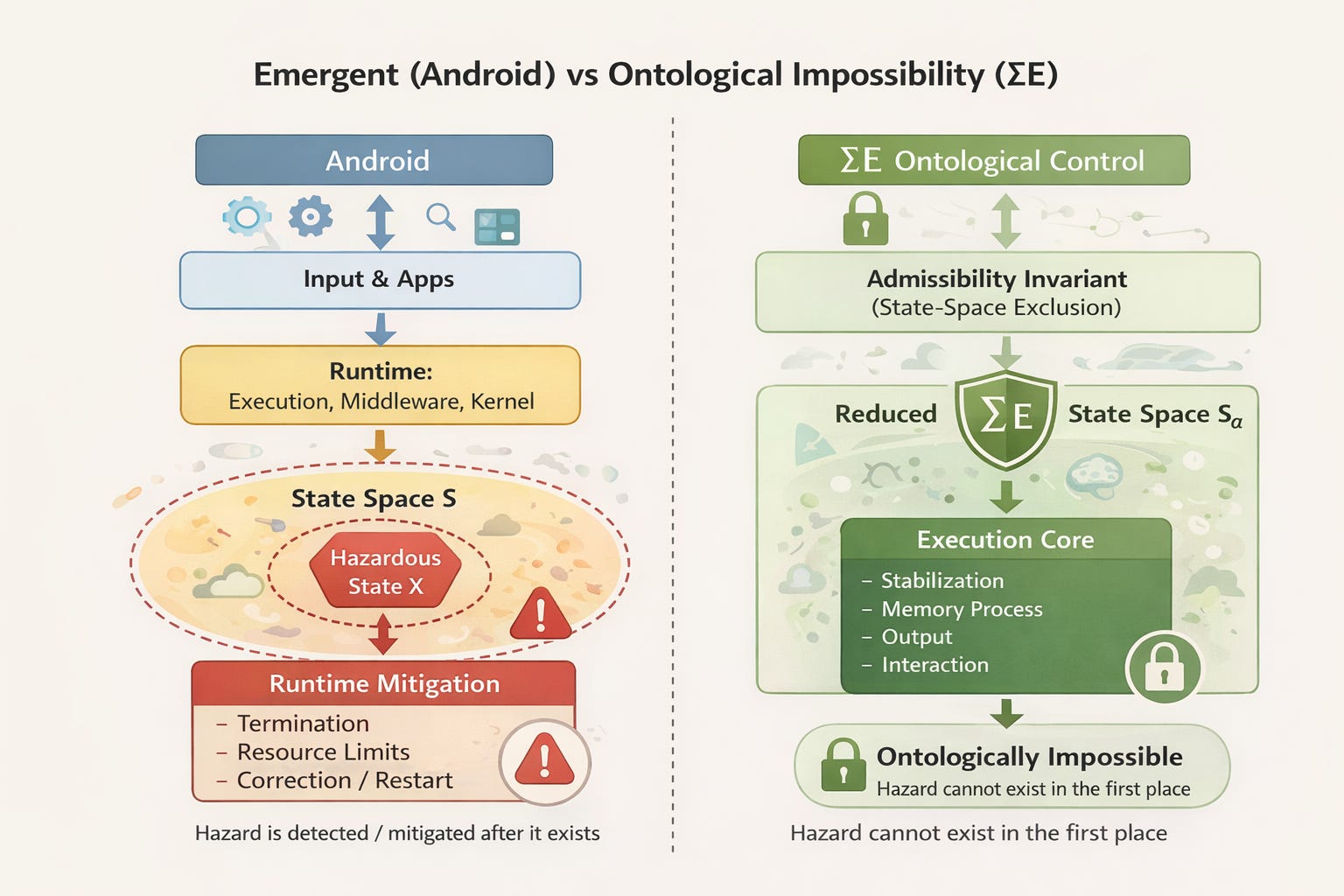
In conventional runtime architectures (left), hazardous states may emerge within the system state space and are subsequently detected, mitigated, or corrected during execution.
In a ΣE-based architecture (right), non-admissible state classes are excluded from the system state space by design. Such states are architecturally non-reachable, non-representable, and cannot be instantiated under any operational, timing, or fault condition.
License & Attribution
© 2026 XREALISM® — Dr. Ladislav Gradečak
This text and the accompanying architectural concepts are provided for explanatory, educational, and discussion purposes only.
They describe a high-level architectural framework and do not disclose executable logic, implementation details, or proprietary mechanisms.
Any reproduction, redistribution, implementation, or derivation of these concepts for commercial or operational use requires prior written consent from the author.
All rights reserved.
#SystemArchitecture
#PreDecisionStability
#SafetyByDesign
#OntologicalControl
#Admissibility
#ArchitecturalInvariants
#RiskBeforeRuntime
#ResponsibleSystems
#SystemsThinking
#DesignNotMitigation